
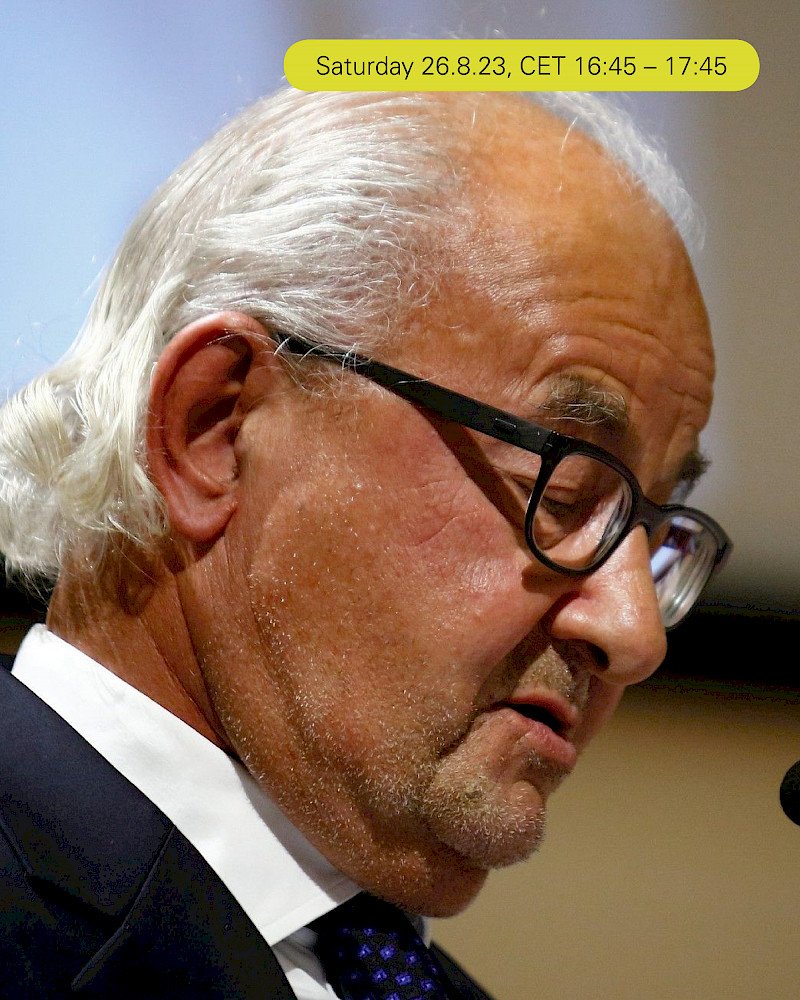
Date
25 August 2023
Time
16.45 – 17.45h CET
Location
onsite in Zurich, Toni Areal, Pfingstweidstr. 96, 8005 Zürich – Kammermusiksaal 1 – Room 5.K13
Description
What was nature?
Oh, it was various things. It was always different. It was, at least in the
human interpretation, the sea god Proteus.
It was the regent of everything in the Greek antiquity
the measure of man in Roman times
the creation of God in the Middle Ages
a many-faced lump of dirt in early modern times (Descartes)
the big picture in the beginning modern age (Voltaire)
a counter-image to humanity in Romanticism (Novalis)
the origin of man as of all other living beings in the science of the 19th century (Darwin)
an inexhaustible raw material resource for the economy of the 19th and 20th century
And what is it today?
The lost womb, a source of impending catastrophes, a contributor to hybrid creations, an element in amalgamations of nature, culture and technology…
Is nature still to be saved?
Better: are we still to be saved?
Proceeding from this brief history of the manifold aspects of nature, Wolfgang Welsch and Jörg Scheller will discuss how nature is produced and reproduced in today’s popular culture. A selection of pop artifacts, from music videos through paintings to fashion items, will serve as cornerstones for the dialogue.
Wolfgang Welsch was professor of philosophy at the Free University of Berlin, the Humboldt University of Berlin, the Universities of Bamberg and Jena, Stanford University, and Emory University. He shaped and established the concept of “transculturality” in the humanities. In 1992 he received the Max Planck Research Award and in 2016 the Premio Internazionale d’Estetica. His research interests include anthropology and epistemology as well as philosophical aesthetics. Welsch has published numerous books and lives in Berlin.
Jörg Scheller is professor of art history at the Zurich University of the Arts, Department of Fine Arts.